Beit Yeshua
Something to Think About

Feast of Trumpets
Yom Teruah
"One Long Day"
by Cathy Hargett
Dealbreakers
by Cathy Hargett
Sound the
Alarm
by Cathy Hargett
The
Consolation
Of Israel
by Cathy Hargett
Why I Care
About Israel
by Cathy Hargett
Hag Sameach
& SHAVUOT
by Cathy Hargett
Messianic
Gentiles
by Cathy Hargett
Messianic Jews &
Highway to Zion
by Cathy Hargett
Cowboy-Up
& Quit Whining
by Cathy Hargett
Israel
by Curtis Loftin
Hanukkah
by Curtis Loftin
Isaiah 62
6I have set watchmen upon thy walls, O Jerusalem, which shall never hold their peace day nor night:
ye that make mention of the LORD, keep not silence,
7And give him no rest, till he establish, and till he make Jerusalem a praise in the earth.Psalm 122:6 Pray for the peace of Jerusalem: may they prosper who love you.
The following are thought provoking articles written by friends of Beit Yeshua.
They were too good not to make them available to others.And other sheep I have which are not of this fold; them also I must bring, and they (the Gentile believers) will hear My voice; and there will be one flock and one shepherd. John 10:16
Feast of Trumpets - Yom Teruah
One Long DayThe following is an article by Cathy of Highway to Zion
Shalom, Shalom and La Shana Tova!
Yom Teruah, a beautiful Feast, combining the sacred call to celebrate the Feast of Trumpets and the civil new year - today's modern-day celebration of Rosh ha Shana, the head of the year, the first day of Tishrei - this is a Feast which embodies great mystery with commandments that the Lord does not choose to explain in detail - sound the shofar as a memorial, gather for a sacred assembly, do no regular work, but present offerings, a day of rest......(Lev. 23:23-25; Num. 29:1-6).
Because this Feast falls at the new moon and because it's difficult to tell exactly when one day becomes another, just to be sure, the feast is celebrated for two consecutive days. According to rabbinical tradition this two day celebration of Yom Teruah is considered “one long day” or “yoma arikhta”.
Since this is one of the Feasts yet to be fulfilled, and it is very likely the Feast that represents the rapture of believers, it is no wonder that the Lord chose to shroud it in such mystery (Matt. 24:36). Surely ha satan will not know when the great trumpet shout will be sounded. The Lord will surprise us all even though He has allowed us to understand many things about it.
The season of the Fall Feasts of the Lord have become so meaningful to me as the Lord has appointed these days for His people to meet with Him. This is a season like no other - the biblical season that foretells and assures that what we long for will come to pass.....our Messiah is so near us. Soon, we will hear the great shout, the great trumpet blast from heaven (I Thes. 4:16).
Every part of this Feast Day touches me so deeply - the sound of the shofar - the voice of the trumpet - the "not-of-this-world" sound of tekiah, shevarim and teruah. (Num. 10:1-10) These are the descriptions of the trumpet blasts that are traditional in celebrations of the Jewish people and Messianic believers all over the world.
When I hear the sound of the shofar something happens to my spirit that I can barely describe - a hush over my heart - an exquisite longing for the One who is coming for me - and a great desire for the Lord to have what He so deserves - a people, clean and pure and holy unto Him.
I am challenged by this season of repentance. He's taught me, and continues teaching me, about the darkness of my own heart unless I allow the searchlight of the Spirit....it pains me to see myself for who I am when I'm not covered with Him. Through this Feast and that ethereal "shout", whether by shofar or voice, He allows us to hear Him and to participate in His thunderings. How I long for this heaven-and-earth unity of the shout, the trumpet blast, to shake all the wrong foundations that need to be shaken (Rev. 11:15).
And from the perspective of His people, Israel, and the teachings of their rabbis and sages from ancient times, I am eager to forgive and to be forgiven, to make right all the wrongs, first with Him and then with others who I have sinned against or who have sinned against me because the day of the closing of the gates will come. Yes, Lord, a season of repentance, of cleansing, of making right all the parts that we are responsible before You to do and then to receive, in great humility, the atoning Sacrifice that takes away the judgment that is so due us.
Join me in prayer - Yeshuati, my Jesus, my Salvation, my Heavenly Shofar, Trumpet of Salvation, awesome, Holy King, thank you that you are Yom Teruah, the Feast of Trumpets, the One who shouts from heaven, a holy Sound that only our spirits understand. (Ps. 18:2; Isa. 42:13; Ps. 98:6; Ps. 89:15-17; Ps. 47:5; Ps. 27)
Oh, Lord, thank you for calling us to celebrate Yom Teruah.
Raise your voice like a trumpet (Isa. 58:1), sound the shofar, issue the warning for repentance, and proclaim His soon-coming.
Blessings, love, and holiness in our Messiah,
CathyDealbreakers
Which Church or Congregation Will You ServeThe following is an article by Cathy of Highway to Zion
Shalom, Shalom, Friends!
Just pondering today about our whole modern-day concept of "church". And I've thought so much about the years that I've spent in congregations. I'm not a "church-hopper". In fact I am a highly committed person when the Lord leads me to take my place in a group.
For example, I was raised Presbyterian and remained Presbyterian for the first 21 years of my married life - I will, however, confess that I was a "closet-Charismatic" Presbyterian for a couple of years, then became an "out of the closet-Charismatic" for the rest of the years!! This did present some interesting moments for me in this buttoned-up denomination! When I embraced the Word of the Lord concerning Israel I become even more of a "problem child" in this denomination.
I was a member in good standing of a Pentecostal church for 16 years. Today and for the past 3 years I've been a member of a non-denominational church with a vision for unity in diversity, and the church also offers a Messianic service once a month.
So, I've always been involved in and a part of a larger group of believers who were accountable to a pastor and/or a leadership team of varying biblically structured designs. I believe in the assembly of believers and in righteous authority structures according to the Scripture.
I am becoming more and more convinced, however, that these mega-large assemblies are for preaching and listening and corporate worship but the true "living it out faith" comes when we are together in smaller groups of believers who are accountable to God and each other. In a mega-size group we are confined in so many ways, not the least of which is simply the logistics of dealing with a large group.
It has become more and more important to me that the authority structure that I have submitted myself to is Biblically correct on the issue of God's Word concerning Israel, the restoration of Israel, the coming of Messiah and the restoration of all things.
It troubles me also that most of us have spent many years in congregations with a minimal interest in the restoration of Israel and extremely minimal giving for the purpose of building up Zion, even though the view "all the tithes come to the storehouse", and the storehouse means the particular church where the congregant attends, is pretty much the accepted dogma of the church. Most churches give for good purposes but what about giving for Zion's sake in addition to giving for the new gym? We should at least express our desire that we give for Zion's sake to our church leaders. If they don't agree, we need to give offerings to the Lord for Zion's sake whether our church homes give or not! Basically, God's Word concerning Israel has simply not been a priority in most of our churches.
My belief system includes the beliefs of most Orthodox Christian believers plus the belief in God's plan for Israel through His covenant with Israel and the Jewish people. Today I call myself a "Messianic Believer" or a follower of Yeshua. Most of the time I use this term instead of the more conventional term, "Christian", and I do this because I want to identify with the Lord's plan for the restoration of the world through Yeshua ha Mashiach (Jesus the Messiah), the Lion of the Tribe of Judah. I want to identify with Him and His ways and the choice He has made of Israel to proclaim and make Himself known.
I believe there is only One God, the God of Abraham, Isaac and Jacob. I believe in Yeshua ha Mashiach, the incarnate Son of God. I believe in the Father, The Son, and The Holy Spirit. I believe there is only one way to receive salvation and that is through the precious blood of Jesus, the Atonement for our sins, whether a person is Jew or Gentile. See our website and click on the tab "Statement of Beliefs" for a detailed statement of beliefs.
All of these statements on our website are dealbreaker beliefs for me and for us in Highway to Zion Ministries. In other words, these are fundamental beliefs that cannot be compromised. God's Word concerning Israel is one of these dealbreakers. This is not one of the dealbreakers in most statements of belief in Orthodox Christianity. In fact, most of the time it is not even mentioned. In this way our belief system is very specific. This is not an optional belief for us.
Now I'm getting to the point - I have found that over the years as the Lord has increasingly poured His Truth into my heart about His plans for Israel and the restoration of all things that I am no longer able to embrace, join, and serve in a church that does not include these truths in their ministry in some way, hopefully in some profound way.
It's a dealbreaker for me. A church or congregation that has no interest or position on God's Word concerning Israel is not the place to be. We must know that we know that we are not in a place that is teaching "replacement theology". Replacement theology is the teaching that the "church" has replaced Israel and that Israel is no longer prophetically relevant.
Each of us may have a different standard of acceptance in terms of just how focused the leadership in their place of worship must be in expressing and holding these beliefs in order to satisfy our convictions. But the truth is that if we are in a place that is disinterested in this major truth that drives the fulfillment of the end of the age, then we probably should start praying in earnest about where we will worship going forward!
On the other hand, in some cases, the Lord is using people who believe His Word about the restoration of Israel in order to stir up the waters around them and to proclaim the truth in the midst of unbelief. If you are one of those "stirrer-uppers", it could be that you get to stay where you are for a season, at least until He is done using you there!
It's interesting that I have been very fervent about other issues of faith in my life in addition to fervency for Zion's sake. Namely, during the days of my "Charismatic coming-out" season, one of the first things I wanted to know about a church or a group was what stand did they take on the expression of spiritual gifts like the controversial "speaking in tongues" issue.
However, these issues about spiritual gifts are not dealbreaker issues for me. They matter to me, but these are not dealbreakers. An unbiblical stand on Israel is a dealbreaker. I'm not sure if you've given this much thought. If you haven't, I am believing that you will be giving it more thought now!
You may be in a place where there is correct belief on the subject of Israel but the expression is so marginal that you are starved for deeper truth. Perhaps you are somewhere where the basics are taught with great zeal, year after year; i.e., repentance, baptism, salvation, etc., but you never see deeper into the heart of God concerning His prophetic Word. You are saved but you are not walking in the fullness of your destiny.
You may be in a place where the pastor all but forbids you to take advantage of parachurch organizations that have expertise on the subject that the church he leads is lacking. I recommend that you pray this through and ask the Lord if He wants to broaden your spiritual understanding beyond what you know now. You are responsible for yourself before God to seek His Truth as He leads you. This does not mean that you would leave your church home, it simply means that you would pursue the Word more deeply on your own, in addition to what you are receiving in your home church, as the Holy Spirit is speaking to your heart.
If you will seek Him with all your heart regarding His Word concerning Israel, you will walk deeper in your destiny, and you are not going to fall asleep and spiritually die without ever knowing that there is a powerful move of God taking place right now, in front of your eyes, as the Lord fulfills His Word concerning the restoration of Israel.
Messiah is near us.
Know your dealbreakers. Walk in your destiny.
For the Glory and Love of Yeshua,
CathyThe following is an article by Cathy of Highway to Zion
Shalom, Shalom, Friends of God!
Today, like many of you, I am continuing to pray and meditate on the recent meeting between the President of the United States and the Prime Minister of Israel regarding the "Israeli-Palestinian conflict". Each of you will have to do your own praying, studying, and background research on this subject and come to your own conclusion, using your Scriptural foundation to guide you.
As a person who has taken a stand for Israel according to the admonition of the Scripture (Isa. 62), I continually and passionately express that my heart for Israel is Scripturally motivated and not politically motiviated. My whole heart loves God's Word and His choice of Israel to reveal Himself and to bring salvation to the world through her in Messiah Yeshua. To me, it is beyond belief that any believer who knows the Word would take the stand that it is right to divide up the Land of Israel and take it from the Jewish people.
My heart today is to sound an alarm - if I had a shofar in my hand and you could hear it being blasted right now, I would surely sound it!
The alarm is this - do not be deceived by this forcefully emerging faction of Evangelical Christianity, which is now taking an anti-Zionist (and an anti-Christian Zionist) stand and is adopting a viewpoint that some call "Palestinian Liberation Theology."
It is nothing more than replacement theology - which is the removal of the Jews and Israel from the Word of the Lord, and replacing with the "church", the "loving" Gentile believers who are the "true peacemakers" and who have now replaced Israel as the true people of God.
Be aware that this stand is anti-Zionist which will lead, and is now leading, others into anti-Semitism, which ultimately leads to anti-Christism. Basically, it is "anti-Scriptural"! This is why it is so deceptive - because it is clothed in words like "peace", "love", "justice", etc. The problem is that the rhetoric is not true.
Here's the progression: Anti-Zion; Anti-Semite; Anti-Christ.
It is happening. The Bible prophesies that in the last days Jerusalem will become a major dividing point, and it is.
The Bible prophesies that the nations will come against Israel, and they are.
The Bible prophesies that in the last days there will be mockers and scoffers about the truth of the Word, and they are here.
Unfortunately, these people are in your churches, sitting beside you in assemblies, teaching and leading classes and influencing others, some in high levels of leadership. And they are standing against the Word of the Lord. Resist their false teaching and rhetoric and their prideful semantics. We must not be deceived. This truth about God's love and plans for Israel is fundamental to our faith. It is not one of the "optional teachings" where we may "agree to disagree". This is basic Truth, and the Lord is uncompromising about it. His plan for Israel and the glorification of Jerusalem is essential Truth, from the beginning of the Book to the very end! His choice of Israel never changes. Yeshua will forever be the Lion of the Tribe of Judah!
Here is the way these folks are being deceived and in turn become deceiving themselves - they are smart enough to read the Bible and to see that the Scriptures clearly state over and over again that in the last days the Jewish people will return to their Land. This is clearly and undeniably God's plan. The Land of Israel belongs to the Jewish people - this is Zionism - simply put - Zionists believe that the Land of Israel belongs to the Jewish people - for a Christian Zionist - it means that that we believe the Scripture teaches this truth.
So how can a self- professed evangelical believer be against the modern state of Israel and for the dividing up of the Land of Israel, particularly the heartland of Israel. Many of these people do know the Scripture about God's plan for Israel, so the only choice these anti-Zionists have is to say that the existence of modern-day Israel is not the fulfillment of biblical prophecy and that modern-day Israel has no biblical relevance.
Study the Word, seek out the specific Scriptural foundations concerning Israel, the return of the Jews to the Land, (some examples: Isa. 11:11-12; Jer. 16:14-15; Ezek. 36:8-12; 24-36) and God's anger against those who divide up His land (some examples: Joel 3; Ezek. 36:1-10). These are not hard to find Scriptures - these passages are profuse. They are not hidden. They are very clear.
In our day, we are seeing the prophecies being fulfilled in the Land of Israel as the Jewish people return from the North, the South, the East and the West. We have seen a nation be resurrected from the dead! Yeshua Himself tells us that the Jewish will say "blessed is He who comes in the Name of the Lord". He will return to Jerusalem, the capital established by King David. These promises are literally true. It is the most joyful, hope-filled news that He promises us! Believe it and embrace it, and be part of preparing the way for the Lord!
Be prepared to take your stand. The dividing line is growing more and more distinct in these last days between those who stand on the Word of the Lord and those who do not. Do not be deceived.
Blow the trumpet in Zion! (Joel 2:1)
Love and Shabbat Shalom,
Cathy
The following is an article by Cathy of Highway to Zion
I pray this letter finds you well and thriving and accepting this season of your life, regardless of what it means. For some of us, it is a time of peace and joy, with no severe life challenges. For others of us, it is an extremely trying time requiring perseverance and endurance.
Regardless of which category you find yourself in today, one thing is for sure, to everything there is a season, a time for every purpose under heaven (Ecc. 3:1-8). I don’t know if it’s my physical age and life’s experiences or if the Lord has just finally been able to get through to me the truth that no matter how difficult life is, He has His own purposes in mind. He has allowed every situation and maybe even orchestrated some of them (Ps. 139:16)!
If you belong to Yeshua, and you are seeking Him with all your heart, you can rest assured that whatever situation you find yourself in right now, it will be for your good and for the glory of the Kingdom (Rom. 8:28). The Holy Spirit has brought such a sense of purpose to my heart over the last couple of years of intense challenges (II Cor. 4:16-18). I am praying that you are receiving that same sense of purpose in your own life and that if you haven’t seen your circumstances in this light recently, that you will and that you will be consoled and encouraged and empowered by the Ruach (Php. 3:7-11).
I love the name that Jesus is called in Luke 2:25, “the Consolation of Israel”, and He is so that! He is the One who comforts, who provides solace and relief and support from heaven. I am consoled by His Presence, comforted by His grace, and energized by His Spirit. I find that the words “I’m so looking forward to seeing the Lord” are really true in my heart. He is the Hope. I am grateful that my spirit is full of the Hope of His coming and the Hope of His glory and the Hope of seeing Him face to face (I Cor. 13:12).
Here’s what I want to do – I want to give Him glory, now, in these days of trial and affliction (Isa. 40:3). By His grace, this is the goal of my heart. I pray for all of you, dear friends, who may be enduring, and I pray that as you lean into Him and cling to Him and fight the fight of faith (I Tim. 6:12) that the certainty of His purposes being fulfilled will so encourage you. He came to destroy the works of the devil (I Jn. 3:8b). He created us to do the same thing, and this endurance and perseverance to the end is one of the ways we do it. Hold fast. Stand firm. Defeat devils in Yeshua’s Name.
Thanking God for your friendship and for the love we share as sold-out followers of the One called Faithful and True!
In the Love of Messiah,
Cathy
Highway to Zion
December 29, 2010The following is an article by Cathy of Highway to Zion after she returned from Israel in 2010
For about 27 years now I have been deeply connected to the Word of the Lord concerning His plans for the restoration of Israel.
In fact, I’ve been so deeply connected with the truth about this subject that often when I am in the midst of sharing, I am perplexed when I suddenly realize that what I am sharing is news to many believers.
One of the most astounding issues that comes forth is that many, if not most, believers consider Israel to be simply one of the many nations that God has created with no special distinction or uniqueness. This is not true. The Bible is about Israel and the nations – two distinct entities.
There are two types of people in this world – one is Gentile and the other is Jewish – these are the two types. Israel represents the Jewish people and all of the rest of the nations of the world are Gentiles.
With just this small amount of insight, there is a flood of revelation for us as we study the Word. Try the “exercise” below and see what happens in your spirit and in your mind:
Step 1: when you read the Scriptures and the word “nation(s)” appears, replace that word with the word “Gentile(s)” because this is what it means.
Step 2: assume that if the word “nations” is mentioned, the passage is not talking about Israel (the Jews). The passage is talking about the Gentiles.
Step 3: when the Word mentions Israel, think Jewish people instead of Gentiles. (It is true that as born-again believers Gentiles inherit the promise of Abraham, but for purposes of understanding the Scriptures literally, especially for Israel as a nation, it is helpful to first see the literal and physical meaning and after that, overlay the “identification” process of spiritual truth (do remember that the “church” never replaces Israel!) We must first read what the Word actually says.
This simple change in how you understand the Word will give you so much insight into just how relevant the nation of Israel is in terms of God’s plan of redemption and how their restoration is the signal for the return of Messiah and the restoration of all things.
One profound example of this is found in a familiar passage – Matthew 28:19 – “Therefore go and make disciples of all nations (the Gentiles), baptizing them in the name of the Father and of the Son and of the Holy Spirit”. Jesus is talking to the disciples, Jews, and telling them that their mandate is to make disciples and to share everything He has told them. It is essentially what the Lord told Abraham in Genesis 12:1-3 – that he was to be a blessing to the nations (the Gentiles). The Jewish people were given the mandate to be the instrument of blessing for every nation. He said “all peoples on earth will be blessed through you”.
I recently attended a powerful class on “missions”, and I learned so much from the presentation, but I was troubled that God’s banner for the nations (Israel) was not mentioned as part of the ultimate revelation of the coming of the Lord. In this regard, Israel is unique.
It is to this land given by His covenant to the Jewish people that Yeshua (Jesus) will return in glory. Part of the signal of His return is the re-gathering of the Jewish people to the land of Israel. Yeshua said to His Jewish people words that tell us they will acknowledge Him when He returns because He said that He would not come again until they say “Blessed is He who comes in the name of the Lord”. (Matt. 23:39) Israel will know Him. (Zech. 12:10). The salvation of Israel is imperative before the restoration of all things.
Israel is the foremost of the nations (Jer. 31:7). Israel is God’s choice (Ps. 135:4; Ps. 132:13-14). I’ve heard an illustration that helps explain this truth and the illustration is that it’s not that God loves the nations (the Gentiles) any less than He loves Israel (the Jews), it’s simply that He has given Israel a very different role – somewhat like the roles of husband and wife – both are loved and equal in His sight but the husband’s role is different from the wife’s. He is chosen to be the leader, the head, as Israel is chosen to be the foremost of the nations. It is simply His choice. We can accept His choice and embrace it, or we can reject it, but it is still absolutely His choice. I would not consider rejecting it and you won't either once you get this truth deep into your spirit!
The entire Bible is about the redemption and restoration of the nation of Israel and how the covenant God made with Abraham has been extended to all nations. God promised this would come to pass – Gen. 12:1-3. And it has come to pass on many levels already. Ultimately, all the nations will be judged, based on how they treat Israel!
I realize this may sound outrageous to many people, but this is the truth and it is very clear in the Word. It’s not hidden. You really do not have to contrive a thing to see it. Here are a few examples of the judgment of the nations being based on their treatment of Israel:
Joel 3:2, 17-19; Zech. 12:9; Zech. 14:3-9/Rev. 19:11-16; Ezek. 36:2-12 – to name a few.
Also meditate on Matt. 25:31-46 for a truly profound understanding about the brothers of Jesus – the Jewish people - and how the nations will be separated accordingly – the sheep from the goats.
So, when you see a parade of nations, remember that there is one nation that is hand-picked by God for the revelation of Messiah Jesus (Yeshua ha Mashiach). The story of Israel is God’s story - the story of how God redeems sinful man and makes him righteous and restores him to the state that God originally intended and how God shares His glory with these made-righteous-in-Yeshua new creations!
Why do I care about Israel? Because God chose her. He loves her. He reveals Himself through her. I care because Messiah is the Root and Offspring of David. I care because He will forever be the Lion of the Tribe of Judah (Rev. 22:16). I love Israel and the Jewish people because as Derek Prince pointed out so beautifully when he was with us - without them we would have no Scripture, no promises, no patriarchs, and no Savior (Rom.9:3-5).
The land of Israel is a type of the eternal land of our spirits, the promised land, the eternal home we are promised, the place of His throne. I love this land now as I long for the restoration of all things. I see glimpses of His hand now. I love Jerusalem, the place where He dwells. I love it now and I long for its final glory. Our God desires her for His dwelling place. She is His crown (Isa. 62:3).
Israel is not just one of the nations.
Israel is the foremost of the nations.
Cathy
Highway to Zion Ministries, Inc.
October 13, 2010TTeshuvah
The following is an article is a compilation of several Teshuvah daily devotionals written by Curtis
On the Jewish Calendar Elul 1 is the beginning of a period of time called "Teshuvah". Teshuvah is a 30-day period for repentance before Yom Teruah/Rosh Hashanah/Feast of Trumpets on Tishri 1 (and 40 days before Yom Kippur on Tishri 10). “Teshuvah” is a Hebrew word that means “Return”. Yeshua/Jesus is coming back for a Bride that is without spot, blemish or wrinkle. Only Yeshua can do in reality in our lives what the Mikvah (Baptism in water) did symbolically - cause us to die to self and be reborn a new, spotless before Him. Teshuvah is an opportunity for us to search out the corners and crevices of our heart and see if there is anything that would be unpleasing to our heavenly Bridegroom.
1 John 1
9If we confess our sins, He is faithful and just to forgive us our sins, and to cleanse us from all unrighteousness.This prayer (Psalm 51) was written by King David, who scripture calls a "man after God's heart". David was a Psalmist, Worshipper, King – as well as an Adulterer and Murderer. He was also a "Repent-er". How wonderful that when we have sin, iniquity & transgression in our lives, Yahweh provides ATONEMENT (At - One - Ment, or restoration) for us through the blood of His son Yeshua.
Psalm 51
(Red - From Strong’s Concordance)1Have mercy on me, O God, according to your steadfast love; according to your abundant mercy, blot out my transgressions (rebellion/sin).
2Wash me thoroughly from my iniquity, and cleanse me from my (sometimes habitual) sin.
3For I know my transgressions, and my sin is ever before me.
4Against you, you alone, have I sinned, and done what is evil in your sight, so that you are justified in your sentence and blameless when you pass judgment.
5Indeed, I was born guilty, a sinner when my mother conceived me.
6You desire truth in the inward being; therefore teach me wisdom in my secret heart.
7Purge me with hyssop, and I shall be clean; wash me, and I shall be whiter than snow.
8Let me hear joy and gladness; let the bones that you have crushed rejoice.
9Hide your face from my sins, and blot out all my iniquities.
10Create in me a clean (pure) heart, O God, and put a new and right spirit within me.
11Do not cast me away from your presence, and do not take your holy spirit from me.
12Restore to me the joy of your salvation, and sustain in me a willing spirit.The season of Teshuvah is always special to me – each year even more so as we anticipate the return of Yeshua. This past year however has involved some very unique personal and family struggles. There were times when all I could do was just be on my face before the Lord – times when a miracle from the Lord was desperately needed – times when I had absolutely no strength on my own and had to totally lean on Him. But you know what, His hand was never too short to provide just what was needed – the encouragement – the miracle – the strength – the forgiveness. Perhaps you’ve had similar struggles this year, yet what a loving Abba (Heavenly “Daddy”) we have. Part of our continued walk with the Lord is that “purging” that He CONTINUALLY does in our lives. If He’s coming back for a bride that is without spot, wrinkle or blemish, we have to welcome His work within the various aspects of our lives. We live in a carnal world, and we have to keep our eyes, ears and hearts on Him to keep that carnal world from “rubbing off on us”
According to Judaism, confession is an important part of the repentance process. It is simply not enough to feel remorse and forsake sin (although such feelings would indeed be a commendable first step). The Talmud asks the question, "Who is the person whose repentance ascends until the Throne of Glory? — (he is the) one who is tested (again) and emerges guiltless". A person should not simply renounce sin in general, but rather be specific about the sin. The penitent person must literally put his or her feelings into words and essentially say, "Lord, I did ‘such-and-such’ and for that, I am sorry." Excuses for sin and rationalizations of the sin are not accepted at any stage of the repentance process. Verbal confession does not necessarily need to be a confession to another person. Confessing alone usually allows us to be more honest with ourselves and with God. However, confession is slightly different for sins committed against God or one's self than they are for sins committed against another person. True repentance requires the repentant person to approach the offended brother or sister and correct the sin however possible.
Matthew 5:23-24
Therefore, if you are offering your gift at the altar and there remember that your brother has something against you, leave your gift there in front of the altar. First go and be reconciled to your brother; then come and offer your gift.Ephesians 4
31Put away from you all bitterness and wrath and anger and wrangling and slander, together with all malice, 32and be kind to one another, tenderhearted, forgiving one another, as God in Christ has forgiven you. 5:1Therefore be imitators of God, as beloved children, 5:2and live in love, as Christ loved us and gave himself up for us, a fragrant offering and sacrifice to God.This scripture is so important to our Teshuvah experience. Have you ever noticed how quickly we are to share the “latest news” with others about a brother or sister or to let them know when we don’t like someone? Ephesians says we're not to allow bitterness, wrath, anger, wrangling, slander or malice to exist in our lives. We're suppose to "put it away". That's sometimes hard to do with those who have hurt us, said things about us that aren't true, or talked about us out of jealousy behind our backs. Yet Paul is explicit in his inspired writings to the Ephesians - we're suppose to live in love - even as Messiah loved us. WOW! That's sometimes hard to do, but it should definitely be our goal.
The summer has been a long hot one with temperatures hovering in the upper 90s, but before long we’ll start to feel a change in the outside temperatures. We’ll notice a coolness in the air as leaves begin to fall off of the trees in our front yards. As the first signs of the Fall season approach we are reminded that seasons change in our walk with God, too. Just as we need to prepare for the fall and winter seasons on a physical level, we need to prepare our hearts for the change of spiritual seasons which provide us with wonderful opportunities to draw closer to the Lord – and grow in Him.
I’ve been a worshipper from the time I was a young man. Carolyn & I had been accustomed to setting aside “special” days for the Lord even when we were in college, but it was hard to find a place where we could get together and yet be alone with the Lord. We’d call them our “date” nights with the Lord. We’d pick a time and place and several of us would gather and spend hours in praise, worship and prayer. Frequently it would be the Episcopal Church – which was one of the few churches in our college town that they actually left unlocked on campus for student use. It wasn’t unusual to start praying with one group of people and a different group be there when the evening was over. One of our favorite places was the chapel at First Baptist Church. We’d actually “slip” into the chapel before it was locked up, carrying our Bibles, a record-player and some records (does that date our age?) and for the next few hours we’d get alone with the Lord. We’d sit, or lay, on the floor and talk to Him about EVERYTHING. We were in love with Him and loved to just sit and talk with Him.
These intimate times continued even after we were married. Surprisingly enough, we set aside Friday evenings as our “date night” with the Lord. We’d minimize the lights and put on some Hosanna Integrity cassette (obviously a different season – from records to cassettes) and spend the next few hours in the Lord’s presence – worshipping, praising, dancing, lifting our hands, praying. The kids were small but when the music started and the lights went dim, they came from their bedrooms into the den where we were to be with us. It was as if they were drawn – we didn’t require it – they just came. I’m reminded of the scripture, “train up a child in the way he should go and when he is old he’ll not depart from it” – thankfully both of ours love and serve the Lord today and still share a wonderful relationship with us. When I learned that the Biblical Sabbath was from Friday evening till Saturday evening, my mind instantly went back to those “date nights” that Carolyn and I had with the Lord in college – and after we were married. It seems that the Lord had been directing our paths all along – even without our knowing it. Seasons of preparing our hearts. Seasons of teaching us to hear and follow His voice. Seasons to learn how to love and trust Him. Seasons to be intimate with Him.
Carolyn and I would frequently meet at the Episcopal Church in our college town to spend time with the Lord. We used the Episcopal Church because they never locked the doors. Even after someone stole some implements & decorations, they still refused to lock the door and simply put a written request on the door that the items be returned.
The Lord’s voice was always clear and recognizable to us when we met at the Episcopal church. We’d usually start off praying together but would eventually move to a solitary corner or pew to spend more intimate time with Him by ourselves. I’d pour out my heart to Him about my cares, concerns, wishes and dreams. Sometimes I’d talk to him about teaching school and about the students I was teaching in my 6th grade internship at the local elementary school. Once I remember telling Him how much I enjoyed it when the students came up to me at school and would talk to me personally about themselves and what was happening in their lives. His response to me was, “Then you know how I feel. I feel the very same way. I, too, enjoy it when you take the time to talk to me – spend time with me – share what’s happening in your life – and ask for my guidance and direction.”
It wasn’t unusual to spend 2 or 3 hours in His presence – praying, listening to records and worshipping, just resting in Him.
It was also in this same Episcopal church that Carolyn asked the Lord if she’d be getting married before the Rapture – and if so, to who! On this particular occasion she had gone to the church to pray and spend some time with the Lord – all by herself. After asking Him if it was in her future to marry before the Rapture, she opened her Bible to Psalm 19:5 and her eyes fell on the portion that said, “Which is as a Bridegroom coming out of his chamber…” – not knowing that I had just left my dorm room and was headed to the Episcopal Church (not knowing that she was there).
He’s so very faithful – caring about EVERY area of our lives – wanting us to seek His face and trust Him for everything – not because He needs it, but because we do.
It’s difficult to walk in worldly sin when you’re deeply in love with Him. It’s only when we take our eyes off of Him for too long that we begin to stray, wander and even drift away. Why would we ever do that – but we do.
The wonderful think about Teshuvah is that it reminds us that He still loves us. He still wants to spend time with us if we’ll repent and turn to Him.
Have you ever been so hungry for the Lord that you would do anything (regardless of how foolish) just to spend time with Him?
My college roommate, Bill, and I had tried praying in our dorm room on campus, but the walls were thin and the sound carried easily. I was already Baptized in the Holy Spirit, so prayers were not always “quiet”. There were times when we just want to SHOUT and bless the Lord. We sometimes prayed quietly, but there were times when we were loud, too, especially when we’d crank up the music (listening to LAMB or one of Maranatha’s PRAISE Albums). That didn’t make us real popular with all of our dorm mates.
The Episcopal Church was a great place to pray, BUT you seldom had the space to yourself. You’d start with one group of people and 2 hours later there would be another group that you didn’t even know. Sometimes that was good, but other times it just made us desire a place to be alone with Him.
We eventually learned that the chapel of the 1st Baptist Church was unlocked during the day and that afforded us some great times alone with the Lord. Carolyn, Bill and I would go there in an attempt to spend some more intimate time in prayer.
On one occasion Carolyn, Bill and I decided we wanted a “date night” with the Lord. We agreed to meet in the 1st Baptist Church Chapel just before they locked the doors for the evening. Carolyn was the first to arrive in the chapel and waited on Bill and me. Shortly after she arrived, she realized that someone was coming into the chapel and that it wasn’t Bill or myself. It was the church janitor! Her first reaction – lie down on the church pew and lift her feet. She did – and WASN’T discovered. She also didn’t sit up right away – fearing he’d turn around and return to the chapel.
At the very same time, I was just starting down the long hall connecting the various corridors and Sunday School room behind the large sanctuary and smaller chapel. Suddenly I was aware that someone from the other end of the hall was beginning to turn off the lights. I knew if I was discovered, that I’d be asked to leave – so I took off in the other direction. Every time I turned down one hall, it seemed the janitor was coming in the very same direction – turning off light after light.
I eventually found myself in the stairwell, but was determined NOT to leave without spending time with the Lord. Instead of exiting the building, I headed up the winding stairs to the 2nd floor landing – only to discover the door to the 2nd floor hallway was locked! Suddenly I heard his steps starting up the stairs, so up I went to the 3rd floor landing. To my regret, the doors to the 3rd floor hall were also locked!
I heard the janitor try the doors to the 2nd floor hall to be sure they were locked and knew it was only minutes before I’d be discovered. What was I suppose to do when he rounded the corner of that final flight of steps to the 3rd floor? … say “Hi! How you doing!”
I said, “Lord, he’ll never believe my motives were innocent and that all I wanted to do was pray in the chapel. I had visions of jail & the police – but to my amazement, he stopped after checking the doors on the 2nd floor hall and went back down the steps and exited the building!
Phew! I couldn’t believe the janitor had heard the sound of my pounding heart! I EVENTUALLY left the safety of the 3rd floor landing and headed to the chapel where Carolyn was waiting. I let Bill in through the side door and the three of us spent several hours in His presence – at first together – but eventually by ourselves – just us and Him!
Have we lost that desire of intimacy with the Lord and settled for an hour on Sunday or Wednesday? Have we become so involved with work – or even family and church – that we don’t have time for intimacy with HIM? Dennis Jernigan describes “intimacy” with the Lord as “into me see.
After college and marriage, the Lord gave us an Interdenominational Spirit-Filled Church to raise our children in. Leaders in the church just assumed (as did I) that since I was a school teacher, my calling was to lead Vacation Bible School and work with the Youth in the church. Even though I was a school teacher by trade, my heart was in a different location when it came to church ministry. Surprisingly, the Lord moved me into leading praise and worship at the church Carolyn & I attended in Catawba County. We had attended a Charismatic Bible Study in college and knew more scripture songs than anyone – and we loved to share them with friends from church when they came to our home to visit. We began studying the Tabernacle of David and learning what it truly meant to worship the Lord as David did – sometimes singing a known chorus or hymn and at other times a “spontaneous” or “new” song. It was during those years that the Lord began to direct our paths toward the Jewish Roots of our Christian Faith. The only “Messianic” music group at the time was LAMB (with Joel Chernoff & Rick Levi Coghill) and we had been collecting their records ever since we were in college. (Isn’t it interesting how the Lord directs your path – even when you don’t realize He’s doing it?) Paul Wilbur was an unknown singer at the time and was just starting a new group called "Israel’s Hope" when we first heard them at a Festival Conference in SC. Everywhere we went it seemed the message was about “Restoration” – a restoration of David’s Tabernacle – a restoration of Praise & Worship – a restoration of “spontaneous” praise (a “New Song”) – a restoration of Davidic Dance (Israeli Folk Dance) – a restoration of the Biblical Festivals and Shabbat – a restoration of the Jewish Roots of our Christian faith – a restoration of the Jewish people and Israel - and most recently a restoration of Torah. Some saw what God was doing as bondage, yet others saw the freedom of worshipping the Lord at His appointed times and in His appointed ways. As we get closer to the time when Yeshua will return, the church will again begin to again resemble the early church – which was (for the most part) Jewish.
Carolyn & Curtis (1975)

Scripture speaks specifically about three types of sin with our lives: (1) sin, (2) iniquity and (3) transgression. Is there a difference?
(1) The word "Sin" comes from the Hebrew word CHATTA'AH, which is translated as "sin, offense, lead astray and to miss the mark". These are "accidental sins" - or sins committed without our being aware of them.
(2) The word "Iniquity" comes from the Hebrew word AVON, which is translated as "sin, mischief, iniquity, moral evil and perversity". Iniquity is "willful sin" - we knew it was sin and did it anyway. It's a willful violation of Torah - things we can't claim to have done in ignorance. It gives new meaning to the old slogan, "Avon Calling!" (Sin Calling).
(3) The word "Transgression" comes from the Hebrew word PESHA, which is translated as "sin, transgression and rebellion". It's "Rebellion" against Yahweh Himself.
And how about those (1) sins, (2) iniquities and (3) transgressions in our lives?
Isaiah 53
5 But He was wounded for our TRANSGRESSIONS, He was bruised for our INIQUITIES: the chastisement of our peace was upon Him; and with His stripes we are healed. 6 All we like sheep have gone astray; we have turned every one to his own way; and the LORD hath laid on Him the INIQUITY of us all.Lord, forgive us for our sins (even those sins we aren't aware of), wash away our iniquities (the willful sins within our lives), and blot out out transgressions (the rebellion within our hearts). Abba (Daddy/Father), teach us to seek Your face instantly when sins, iniquities and transgressions try to enter our lives. Cause us to remember our Betrothal to Yeshua. Help us keep our lamps trimmed, and dress us in wedding garments without spot or blemish (only through Your Son). B'Shem Yeshua Ha'Mashich (In the Name of Yeshua the Messiah).
The following is an article written by our good friend Cathy of Highway to Zion about the Feast of Shavuot - Pentecost.
Shalom, Shalom!
Chag – it’s one of the words that means festival or feast. The first time I ever saw the word it was on a stand-up card on the table in my Israeli hotel....but it was spelled "hag".....and I thought now that's an odd greeting! I'm not sure I like being greeted "hag"!!
(It actually said "Hag Sameach", which means in loose English translation "happy holidays"! A wonderful dimension of this word is that in addition to meaning feast or festival it also refers to dancing, processing, and of course intimating rejoicing. God is so good. His plan is that we will rejoice as we obey Him by celebrating His feasts – and that we would know Him better as we see Him and experience Him in the feasts.)
It was during the Feast of Tabernacles and it was my first time in Israel. Little did I know that my whole frame of spiritual reference was about to change and that understanding the feasts of the Lord would bring a dimension to my spiritual life like I never imagined and that I would begin to love the whole idea of "hag"!
Many of you have studied the biblical feasts and know what I'm talking about, especially about how our Messiah Yeshua is the fulfillment of each one of them! I'm not going to cover all the feasts with this email article, but I do want to talk a little about Shavuot....also known as the Feast of Weeks, Feast of First-fruits or Pentecost.
This feast occurs 50 days after the second day of Passover (much discussion over this timing among scholars). Background scripture for this feast – Lev. 23:15-22; Dt. 16:9-12; Num. 28:26-31.
The period between Pesach (or Passover) and Shavuot (or Pentecost) is called the “counting of the omer” (Dt. 16:9-10). The omer is actually a unit of measure, a sheaf (barley at Pesach and wheat at Shavuot). A study of ancient times, reveals that this season is when the first-fruits of the harvest are coming forth and a sheaf was brought to the temple during the time from Pesach to Shavuot as an offering to the Lord.
Another beautiful concept comes from the Talmud which relates that the farmer who rejoices to see the first-fruits coming forth would tie a ribbon around the first-fruits to designate that this sheaf belongs to the Lord. (Dt. 26:5-11) I love this concept of dedicating the first-fruits to Him.
I’m thinking of the gifts, the fruits of His life, that He’s put into each one of us, a foreshadowing of the fullness that is to come. In fact, James says we are first-fruits as believers – James 1:18.
These gifts in our lives belong to Him. Tie a spiritual ribbon around that gift that He’s given you – perhaps a red one – symbolizing the precious blood of the Lamb that purchased you as His own and gave you every gift you have.
Whatever that gift is – whether it be prophecy, serving, teaching, exhorting, giving, leading, or showing mercy – it belongs to Him now. It’s right to assess what you have been given by God (Rom. 12:3), the first-fruits of His eternal plan for you. It is just the beginning – the first-fruit of what that gift will become throughout eternity. (Eph. 2:10)
Counting the omer, spiritually speaking, could be assessing the first-fruits in your own life and consciously dedicating these to God, knowing that ultimately the fullness of Yeshua will be revealed in your life. (I Cor. 13:12). Count the omer and bring the sheaves to Him!
This counting process, from the date of Pesach until Shavuot, ties together the time commemorating the death, burial and resurrection of Yeshua (Pesach/Passover), to the time of the giving of Torah and the giving of the Spirit (Shavuot/Pentecost), symbolizing we would never have Shavuot without first realizing the sacrifice of our Holy Lamb, Yeshua ha Mashiach at Pesach.Some motifs of Shavuot – comparing Original Covenant and New Covenant
Original Covenant – Ex. 19, 20 New Covenant – Acts 2; Jer. 31
The Giving of Torah The Giving of the Spirit
Torah on tablets Torah, Yeshua, on your heart
3,000 slain (Ex. 32:1-8, 26-28) 3,000 live (Acts 2:38-41)
Evidence of God’s covenant with Israel Evidence of Yeshua’s life in Believers
(Torah on tablets) (Holy Spirit in temples of flesh)
Fire, noise, thundering Fire, noise, wind
Spiritual birthday of Israel Spiritual birthday of believers in MessiahThe significance of two loaves being waved before the Lord at Shavuot (see Lev. 23):
…“baked with fine flour, baked with leaven as first-fruits to the Lord” – the concept of “two” could represent two witnesses – throughout the Scripture this concept of needing two witnesses to confirm a truth is related – one example, Yeshua sent out disciples two by two.
The most exciting part about this concept of two loaves is that it could very well represent Jew and Gentile – study the passage in Acts 2:10-11 – this passage relates that at the time of Pentecost reaching fulfillment, those who received the fullness of the Holy Spirit were both Jew and Gentile (proselytes)!
To punctuate this passage, there is also the hint of the Gentile taking part in Shavuot – see Lev. 23:22, where the gleanings of the harvest were left for the alien (Gentile). So, these two loaves could well represent the unity of Jew and Gentile – the leaven (a type of sin) representing that though we still live in fleshly bodies, given to sin, we are still accepted by God as His first-fruits, both Jew and Gentile. (Eph. 2, 3)
Studying the Feasts of the Lord will take you to deeper and deeper realms of understanding of Yeshua Himself. You will embrace the Word for what it says about Israel and what it means literally, spiritually and personally.
There is much more to say, study, and speak concerning Shavuot and all the feasts. I so encourage you to seek Yeshua in the revelation of the feasts.
I also would say that these feasts are progressive – you must first experience Passover (salvation), then Pentecost (baptism in the Holy Spirit), and finally Tabernacles (eternal union with Yeshua) in your spiritual journey if you intend to go from strength to strength until you appear before God in Zion.
If you have not yet experienced Shavuot personally and received the filling to overflowing with the Ruach (Spirit), present yourself before the Lord and receive the Holy Ghost! Let Yeshua breathe His Spirit into you. (John 20:22; Acts 2:1-21)
Celebrate Shavuot!
Chag Sameach!
Love,
Cathy
Highway to Zion Ministries, Inc.The following is an article written by our good friend Cathy of Highway to Zion about Messianic Gentiles
Shalom, Shalom, Friends!
Who is a Messianic Gentile? A Messianic Gentile is a Gentile believer who believes in Yeshua ha Mashiach (Jesus the Messiah) and who embraces and believes the entire Tenach (the "Old Testament/Covenant") as well as the Brit Hadasha (the "New Testament/Covenant").
What makes a Messianic Gentile different from a "traditional" Christian? There is no difference in terms of believing that Jesus is the Messiah and that there is no salvation apart from Him. In this there is total agreement.
Tenach (Old Testament) is still relevant:
One of the differences between a Messianic Gentile and many traditional Christians would include that a Messianic Gentile has embraced all of the Scripture, including the Torah (five books of Moses), the Nevi'im (the prophets), and the Kethuvim (the writings, including Psalms, etc.), which is simply to say, a Messianic Gentile embraces all of the Old Testament as inspired by the Ruach ha Kodesh (the Holy Spirit) and believes that Tenach is the revelation of Yeshua.
Many believers in our modern day church culture have totally disregarded the Tenach and see it as a covenant that has ended or been replaced, but it has in fact been fulfilled in Yeshua. Without it, we will never know the richness of our Messiah and what He has fulfilled.
Yeshua made this clear that He is the fulfillment of the total Word of God, and is in fact, The Word incarnate (John 1), if you can accept this.
"And beginning with Moses and all the Prophets, He explained to them what was said in all the Scriptures concerning Himself." Luke 24:27
"He said to them, This is what I told you while I was still with you: Everything must be fulfilled that is written about Me in the Law of Moses, the Prophets, and the Psalms." Luke 24:44
One of the most powerful revelations that is embraced by Messianic Gentiles is that the Lord has not abolished the Tenach but He has completely fulfilled it, and in this fulfillment we are walking.
"Do not think that I have come to abolish the Law or the Prophets; I have not come to abolish them but to fulfill them. I tell you the truth, until heaven and earth disappear, not the smallest letter, not the least stroke of a pen, will by any means disappear from the Law until everything is accomplished". Matthew 5:17-18
The "Church" has NOT replaced Israel:
A Messianic Gentile does not believe that the "Church", which usually means Gentile believers who believe in Jesus, the Jewish Messiah, has replaced Israel. This stand against what is known as "replacement theology", meaning that the church has replaced Israel, is a hallmark of belief for a Messianic Gentile.
The reason that Messianic Gentiles do not believe that the "Church" (usually meaning Gentiles and including some Jewish believers) has replaced Israel (Jewish people), is simply because the Word is very clear that Israel will not be replaced in God's plan.
"I do not want you to be ignorant of this mystery, brothers, so that you may not be conceited: Israel has experienced a hardening in part until the full number of the Gentiles has come in. And so all Israel will be saved. The Deliverer will come from Zion; He will turn godlessness away from Jacob. And this is my covenant with them when I take away their sins.
As far as the Gospel is concerned, they are enemies on your account; but as far as election is concerned, they are loved on account of the patriarchs, for God's gifts and His call are irrevocable." Romans 11:25-29
Is Highway to Zion Ministries supportive of the belief system of "Messianic Gentiles" as defined above?
Absolutely.
Highway to Zion Ministries stands on the entire Word of the Lord and the revelation of fulfillment in Yeshua ha Mashiach. We are living in a season of profound prophetic fulfillment, including the re-gathering of the Jewish people to the land of Israel and the stirring of the events leading up to the return of the Lord. It is time to proclaim the truth that will set people free, Jew and Gentile.
In the coming weeks, I will be sending additional articles on this subject, which will include the Land of Israel, the re-gathering of the Jewish people to Israel, and the coming "one new man", Jew and Gentile, one in Messiah.
Bless you as you walk out the Word of the Lord in these last days.
Love and blessings in the One called Faithful and True,
Cathy
Highway to Zion Ministries, Inc.The following is an article written by our good friend Cathy of Highway to Zion. Cathy has done a wonderful job of explaining who Messianic Jews are and what our responsibility as Believers is to them.
Shalom, Shalom, Friends!
Who is a Messianic Jew and what do Messianic Jews have to do with Highway to Zion Ministries?
A Messianic Jew is a person of Jewish descent (the question of determining Jewish descent is a whole discussion in itself!) who believes that Jesus (Yeshua) is the Messiah.
With the acceptance of Yeshua as the Messiah, the Messianic Jew embraces all of Tenach (the Original Covenant a/k/a The Old Testament) plus all of the Brit hadasha (the New Covenant a/k/a The New Testament).
What is known today as the Messianic Jewish Movement is the evolution of the movement of believing Jews into a decidedly “Jewish” expression of New Testament faith. In years past when Jewish people came to faith in Jesus, they may have called themselves “Hebrew Christians”, “Completed Jews”, or “Jews for Jesus”, “Jewish Christians”….and other similar names.
So, what is the difference in all of these titles? The main difference is that up until fairly recently (circa ‘70’s-‘80’s), when a Jewish believer came to believe in Jesus as their Savior, they became assimilated into a “church”, which, of course, is made up of mostly Gentiles who live in a Gentile culture in whatever nation they live. And many Jewish believers in Jesus remain comfortable in mainstream churches.
However, the Jewish believer in a mainstream church setting most often finds that there is no place for his “Jewishness” to be expressed in the traditional church, and for all practical purposes, and to most of their Jewish family, they appear to have become Gentiles because they believe in the “Gentile God”, Jesus (Yeshua), so it can be a complex issue involving both culture and faith.
For the majority of Gentiles in the traditional church there was (and still is for the most part) a “disconnect” between the Original Covenant (Old Testament) and the New Covenant (New Testament), resulting in little to no understanding of the Hebraic roots of the Christian faith, which culminates in no understanding that a Jewish believer has a very unique role according to the Bible.
For many in the church, replacement theology (belief that the church has replaced Israel) has been accepted as the norm, prohibiting any real understanding and knowledge of the Scripture concerning the Jews and what Christians owe to them (Romans 9-11). Neither is there appreciation or sense of connection to the Jewish people and their faith and rarely, if ever, a place for any expression of the biblical feasts or other expressions of faith that a Jewish person would have been exposed throughout their life before Yeshua.
Thus, the Messianic Jewish Movement today has formulated a system of belief that clearly proclaims that it is not an oxymoron to be both Jewish and a believer in Jesus, and with this belief system, there is a still-evolving way of expression of these truths.
For the most part, a person who calls themselves a Messianic Jew chooses to express the Hebraic roots of their faith in some way and does not desire to be totally assimilated into a Gentile church, burying their heritage (and this heritage is ours as Gentiles, too, I might add – same heritage because of Yeshua)!
Many Messianic Jews will express themselves in “Jewish” ways (sometimes very biblical and sometimes cultural and sometimes rabbinical). In Messianic Jewish congregations, there will usually be some type of Jewish liturgy, music, dance or other expression of Jewish life, such as bar and bat mitzvahs. But in all of this, Yeshua is the center of worship and acknowledged as the King of the Jews and the God of all.
As you may have already imagined, there is at times conflict between those Jewish believers who call themselves “Messianic Jews” and those who call themselves by one of the other earlier used names, such as “Hebrew Christian” and “Jewish Christian”. There is a distinction between them in terms of faith expression.
Messianic Judaism is acknowledged by both traditional Christians and believing Jews as part of the community of faith of believers in Messiah Yeshua and that these expressions are in agreement in terms of basic tenets of faith. However, traditional Judaism in all its forms, such as Conservative, Orthodox, Reform, and Reconstructionist, does not accept Messianic Judaism as a sect of Judaism, regardless of familiar liturgy, etc.
Now that I’ve said all of this, I want to say that there is even very much more that could be said here, so much more that it can be complex to a detriment! We could say the same about all the differences and nuances in the faith community, couldn’t we?
The main thing is this – the salvation of Israel is coming to pass in our day! Hallelujah! And the numbers of believing Jews are growing and growing. In Israel today, it is estimated that there are as many as 15,000 Messianic Jews and 150 different locations for worship of Yeshua ha Mashiach in the land of Israel. In Israel, a believing Jew is known as a Messianic Jew, but there are still nuances among these believers even in Israel!
There are reports as high as one million for believing Jews in the world. A study in the USA in 2008 stated that there were a quarter million Messianic Jews in the USA at that time.
So, does Highway to Zion Ministries embrace and accept the “Messianic Jew”?
Absolutely!
Not only do we embrace and love Jewish believers in Yeshua, whether they call themselves Messianic Jews, Completed Jews, Hebrew Christians, or whatever, we believe that our calling is to move ahead together until the Lord, by the Ruach ha Kodesh (the Holy Spirit), reveals the full mystery of One New Man, Jew and Gentile, One in Messiah. (Eph. 2 and 3).
We are supporting Messianic Jewish believers in Israel with finances, encouragement, and by going to Israel to serve and worship with them in the land.
We do not believe that we are a “completed product” yet – we’re still a work in progress! I long for the day when all the richness of our faith comes together and we truly are in total unity, the perfect expression of the faith exemplified by Abraham!
I personally long for congregations to continue to spring up that are truly the One New Man that the Lord seeks, both Jews and Gentiles, together, loving and living in what we know will come to pass in fullness, the fulfillment of the total Word in Yeshua.
In the meantime, ministries like Highway to Zion offer places and venues for learning, encouraging and serving so that Messianic Jews and Messianic Gentiles together may express One New Man in our worship, love and unity.
This is a movement, the restoration of Israel, that is accelerating very rapidly in our day towards the final destiny of eternity coming to earth when our blessed Messiah returns. At that time, we will not be focusing on what we call ourselves – Messianic Jews, Messianic Gentiles, etc.! We will only have eyes for the One called Faithful and True!
"The Lord will be King over the whole earth. On that day there will be one Lord, and His Name the only Name." (Zech. 14:9)
Let’s please Him now by loving Him first (Dt. 6:4-5) and then each other (Matt. 22:37-40).
“How good and pleasant it is when brothers live together in unity!” (Psalm 133:1)
Love in Yeshua ha Mashiach,
Cathy
Highway to Zion Ministries, Inc.The following is an article written by our good friend Cathy of Highway to Zion.
Shalom, Shalom, Friends!
“Cowboy up”……that’s a phrase I heard for the first time from my spiritual brother, Dov. If you know Dov, I’m sure you can picture him saying this and without spelling it out, you just understand what he means!
But you know me and you know that I’m going to spell it out! Basically, “cowboy up” means no whining, get over it, step up to the plate, stop feeling sorry for yourself, suck it up, do what you gotta’ do, be bold, be tough, and get on your horse and ride (get on with the program)!
It made me laugh when I heard Dov tell us that after a season of prolonged whining, his wife had said to him that he just needed to “cowboy up”. Actually those words rang so true to my spirit that I’ve thought about it ever since…maybe because of excessive whining on my part! Perhaps you can relate to seasons of whining and complaining, or just feeling down-under, maybe it’s your own fault or even somebody else’s, or just circumstances, or it’s just a pretty difficult episode in history in general.
To put the spiritual spin on it – “cowboy up” means press in, don’t grow weary in well-doing, be bold and courageous, count it all joy when the trials come, don’t be surprised about the fiery trials, don’t let satan outwit you, take up your spiritual weapons, fight the good fight, pull down strongholds, hold unswervingly to the hope you profess, stand your ground, and fight for your brothers and sisters, speak the truth, and don’t let your heart be troubled ….
Just hearing the words, “cowboy up”, emboldens me and encourages me not to be a spiritual wimp but to walk out my faith tougher and stronger and ready to do whatever God requires of me. I’ve never been a big John Wayne fan, but I’m thinking that if you are, this phrase will certainly bring up some visual imagery of a “tough guy”!!
We just have to remember “no swaggering”. It’s all about Him….about His might, His power, His Spirit, His strength, made perfect in your weakness. It’s a matter of the will. Set your face like flint.
The only thing you have to do is "cowboy up"! God does the rest.
Love in Messiah,
Cathy
Highway to Zion Ministries, Inc.Israel The following is an article written by Curtis of Beit Yeshua
Shalom Mishpocha (Family),
The US's continual push for Israel to give away land to create a Palestinian state is not in God’s plan. He gave the land to Israel as an everlasting possession and will not hold those guiltless to try to “divide His land”.
Joel 3:1-2
“In those days and at that time, when I restore the fortunes of Judah and Jerusalem, I will gather all nations and bring them down to the Valley of Jehoshaphat. There I will enter into judgment against them concerning my inheritance, my people Israel, for they scattered my people among the nations and divided up my land.
If you could see a good aerial view of Jerusalem, you’d see the Hebrew letter Shen – which is a Jewish abbreviation for one of the names of God “Shaddi” or Almighty. In Scripture says “I have put my name of Jerusalem”.
1 Kings 11:36
And unto his son will I give one tribe, that David my servant may have a light alway before me in Jerusalem, the city which I have chosen me to put my name there.
The scripture in Zechariah 12:3 is also an interesting one – and it speaks clearly about Jerusalem and those who try to control its fate – that speaks heavily of us because of our involvement. Now we’re pushing for them to even divide Jerusalem.
Zechariah 12:3
And in that day will I make Jerusalem a burdensome stone for all people: all that burden themselves with it shall be cut in pieces, though all the people of the earth be gathered together against it.
God will judge us for our ungodly living if we do not repent. The daily emails I’ve been sending out for Teshuvah (the time of repentance and returning to God) remind us that we serve a forgiving God – but is it too late for America? I don’t know. I believe that every time we lift our hand against Israel, God brings judgment against us. I believe Hurricane Katrina in Louisiana was part of that judgment.
The Biblical Festivals are prophetic and will all be filled by Yeshua. It’s the Fall Feasts that we currently watch so carefully because they point to the 2nd coming of Yeshua. I believe the Rapture will take place on Rosh Hashanah – also called the Feast of Trumpets. It is a two-day festival and if we comes on the feast day, we wouldn’t know the day or hour. Will it be US time zone or Israel?
1 Thessalonians 5:1-4
1But of the times and the seasons, brethren, ye have no need that I write unto you.
2For yourselves know perfectly that the day of the Lord so cometh as a thief in the night.
3For when they shall say, Peace and safety; then sudden destruction cometh upon them, as travail upon a woman with child; and they shall not escape.
4But ye, brethren, are not in darkness, that that day should overtake you as a thief.
We frequently quote this scripture, but often overlook verse 4 – “We’re not in the darkness that the day will overtake us like a thief”.
The “day and hour” scripture that we frequently quote is a Hebrew Idiom that was used in reference to Rosh Hashanah.
Matthew 24:36
But of that day and hour knoweth no man, no, not the angels of heaven, but my Father only.
Regardless, His coming is NEAR.
Shalom & Blessings,
CurtisThe following is an article written by Curtis of Beit Yeshua
Shalom Mishpocha (Family),
The 8-day Biblical festival of Hanukkah begins Friday night, December 11th, prior to sundown (since it’s the beginning of the Sabbath) with the lighting of the first candle (plus the Shamash – helper candle). Two candles plus the Shamash are lit Saturday evening – three candles on Sunday evening – four candles on Monday evening – and so on. Typically candles are lit from right to left – honoring (or lighting) the newest candle first (meaning, left to right). The Shamash, or helper candle, is traditionally a little taller than the others , or sitting a little higher.
HOW TO …
Blessings
This blessing is traditionally only said the first evening.
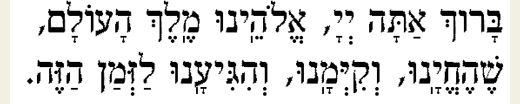
Baruch Atah Ado-nai Elo-heinu Melech Ha-olam
She-heche-yanu V'kiye-manu
Vehigi-yanu La-z'man Ha-zeh.
Blessed are You, Lord our God, King of the universe
who has kept us in life, sustained us
and enabled us to reach this season.The following two blessings are recited every night.
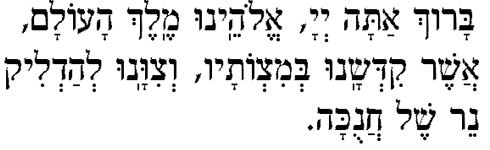
Baruch Atah Ado-nai Elo-heinu Melech Ha-olam
Asher Kid’shanu B’mitzvotav
V’tzivanu L’hadlik Ner Shel Chanukah
Blessed are You, Lord our God
King of the Universe
who sanctified us with his commandments
and commanded us to kindle the Chanukah light.
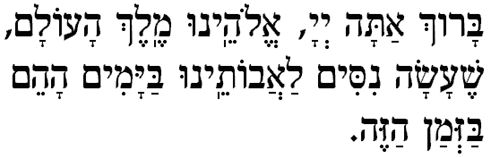
Baruch Atah Ado-nai Elo-heinu Melech Ha-olam
She-Asah Nisim La-avoteinu Bayamim
Ha-heim Ba-zman Hazeh
Blessed are You, Lord our God, King of the universe
who performed wondrous deeds for our ancestors
in those days, at this season.You don’t have a 9-branched Hanukkah menorah but would still like to celebrate the festival? All you need to do is get 9 separate candles – we did the same thing when we started many years ago. I know you and your family will be blessed by observing the festival. The kids will have lots of questions and it’s a wonderful opportunity to tell them how Antiochus Ephiphanes had defiled the temple, but God used the Maccabees to defeat Antiochus, and the temple was cleaned and re-dedicated.
The feast of Hanukkah has traditional foods that are typically eaten during the festival – especially fried potato latkahs and doughnuts.
An early Hanukkah Sameach to you! (Joyous Hanukkah)
Ahava V’Brachot,(Love & Blessings),
Curtis